



Our Approach
At My Bowen Therapy, we believe your body is constantly communicating with you. Our role isn’t to diagnose what’s wrong. It’s to listen, observe, assess and help you understand what your body may be telling you. That’s why every appointment begins with you-not just the part that hurts.
 WhatsApp Us

700+ Google Reviews

22,000+ Clients Supported

TTDI & KLCC Clinics

Established in 2015

Physiotherapists Trained in Bowen

Free No-Obligation Consultation

Helping You Understand Your Body, Not Just Your Symptoms
Most people don’t pay much attention to their bodies until something starts to hurt.
A stiff neck. A sore shoulder. An aching back. A knee that no longer feels quite right.
How We Assess
Your Body Leaves Clues
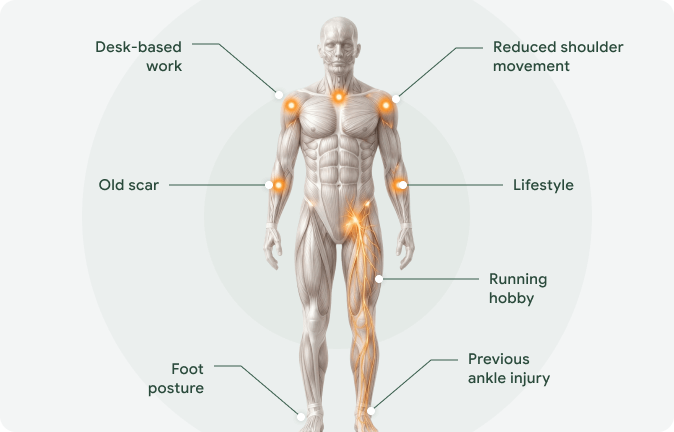
Your body is constantly adapting to the way you live.
Work. Sport. Stress. Previous injuries. Surgery. Everyday habits. Even the way you move, sit or sleep can influence how your body feels over time.
Most of the time, your body adapts remarkably well.
But when aches, stiffness or discomfort keep returning, it may be your body’s way of letting you know that something deserves a closer look.
Many people simply accept these changes as “part of getting older” or blame them on sleeping in the wrong position. Sometimes those explanations are true.
But when symptoms keep returning, we believe they’re worth understanding rather than simply accepting. Think about your car for a moment.
If it starts making an unusual noise, you might turn the radio up for a while and hope it goes away. But eventually, you know it’s worth finding out what’s causing the noise before it develops into a bigger problem.
Your body deserves the same attention.
Rather than ignoring recurring aches, pains or stiffness, or assuming they’re simply something you have to live with, we believe they’re worth understanding.
Not because we jump to conclusions.
But because your body leaves clues.
Why doesn’t the same thing affect everyone the same way?

Two people can sleep in exactly the same position. One wakes up feeling refreshed. The other wakes up with a stiff neck. The difference isn’t necessarily the pillow or the sleeping position. Every body has its own history, movement patterns and adaptations.
That’s one reason we don’t make assumptions based on a diagnosis or a single event. We start by understanding the individual.
That’s why every assessment is different too.
Why Are You Looking at My Hip When My Knee Hurts?
It’s one of the questions we’re asked most often.
Or perhaps: “Why are you checking my foot when my pain is in my back?” They’re good questions.
The area that’s uncomfortable is always important, and we’ll assess it carefully. But it’s rarely the only area we look at. Your body doesn’t move one part at a time. Walking, reaching, bending, lifting and running all involve different parts of your body working together. That’s why we take a broader view.
Previous injuries, surgery, work, hobbies, movement habits and the way your body has adapted over time all provide valuable information during your assessment. Rather than making assumptions, we bring those observations together to help us decide the most appropriate approach for you. Because two people can arrive with the same symptoms and have completely different stories.
We listen through our hands
People sometimes ask what we’re feeling during an assessment.
The simplest answer is that we’re not looking for one magic sign or one perfect answer.
As our hands move over different areas of your body, we’re paying attention to how tissues feel, how they respond and how that fits with everything else we’ve already observed and discussed.
What we feel is never the whole story.
It’s one part of a much bigger picture.
That’s why we often say we listen with our ears, our eyes and our hands.
Assessment Doesn’t Stop After the First Appointment
Many people think an assessment happens once, a treatment plan is made and then the same routine is followed at each visit. That’s not how we work. Every time we see you, we’re observing how your body is moving, listening to your feedback and paying attention to how you’ve responded since your last appointment.
Sometimes we find exactly what we expected.
Sometimes we don’t. And that’s important.
Every response gives us more information and helps us decide what to do next.
Rather than following a fixed sequence, we adapt our approach based on what we observe each time you visit.
A Different Pace One of the things people often notice during Bowen Therapy is that we pause between groups of gentle movements. Those pauses aren’t there because we’ve stopped treating you.
They’re an intentional part of the session.
They give us an opportunity to observe how your body responds before continuing with your session.
That’s why we say we listen with our ears, our eyes and our hands. Every appointment helps us learn a little more about how your body is responding.
Why the pauses?
Think about your computer for a moment.
If it’s running slowly, repeatedly clicking the same button usually doesn’t solve the problem.
Sometimes it needs a moment to process before you decide what to do next. We think about Bowen in a similar way.
After applying gentle Bowen input, we allow a short pause before reassessing. This gives your body time to respond and gives us time to observe those changes before deciding what to do next.
Where Bowen Therapy Fits Into Our Approach
People sometimes ask whether every person receives the same Bowen Therapy treatment.
The answer is no.
Bowen Therapy is the primary hands-on approach we use, but every session is guided by your assessment, what you tell us and how your body responds throughout treatment.
What we’ve observed during your assessment, what you’ve shared with us and how your body responds throughout the session all help guide our decisions.
That means two people with similar aches, pains or movement concerns may receive quite different treatment because they’re different people with different histories, goals and responses.
Why can Bowen Therapy be so gentle?
People are often surprised by how gentle Bowen Therapy feels.
Many hands-on therapies rely on strong pressure, stretching or repeated techniques.
Bowen often takes a different approach.
The gentle movements, together with the pauses between them, allow us to observe your body’s response before deciding what to do next.
Gentle doesn’t mean “doing less.”
For us, it means taking the time to observe before making the next decision.
More Than Hands-On Care
One of the most important parts of your appointment doesn’t involve hands-on care at all.
It involves conversation.
We believe people make better decisions when they understand what’s happening in their own bodies. That’s why we take time to explain what we’re observing, answer your questions and use everyday language rather than complicated medical terms.
Our aim is simple: to help you leave with a better understanding of your body and greater confidence in the decisions you make about your health.
Why I use analogies
I’ve always found that people remember stories better than medical terms.
Whether it’s comparing the body to a suspension bridge, talking about a car that’s making an unusual noise or explaining the pauses during Bowen using a computer, the goal is always the same.
To make something complex easier to understand.
When people understand what’s being explained, they’re more likely to feel confident asking questions and taking an active role in their own care.
Always Learning, Always Improving
When I founded My Bowen Therapy, I made a commitment that still guides us today.
Never assume we’ve finished learning.
Every person we meet teaches us something. Every assessment encourages us to observe more carefully, ask better questions and continue refining the way we work.
Our journey began with Bowen Therapy, but it didn’t stop there.
Over the years we’ve continued to expand our understanding of anatomy, movement, fascia, rehabilitation and the many factors that can influence the way people move and feel.
That same philosophy shapes how we train our therapists.
Learning the Bowen moves is only the beginning.
We also encourage our team to observe carefully, listen well, ask thoughtful questions and continually reassess throughout every appointment.
Because great care isn’t about memorising a routine.
It’s about staying curious, thinking carefully and treating every person as an individual.
That’s why our approach continues to evolve.
Not because our philosophy changes, but because we’re always looking for better ways to understand the people who trust us with their care.
Helping you feel more comfortable is important.
Helping you understand your body is just as important.
We want you to leave with more than a treatment session.
We want you to leave with a clearer understanding of what we’ve observed, why we’ve chosen a particular approach and greater confidence in the decisions you make about your health.
Some people notice changes quickly. Others take more time.
Every person’s journey is different, which is why we don’t believe in following a fixed plan or recommending the same number of appointments for everyone.
Instead, our recommendations are guided by your goals, your progress and what we observe each time we see you. A Partnership in Your Care
We believe the best care is a partnership.
Our role is to listen, observe, assess, explain and provide thoughtful hands-on care.
Your role is to share your experience, ask questions and let us know what’s changed between appointments. Together, we can make informed decisions about your care.
Your Body Leaves Clues
If it starts making an unusual noise, you might turn the radio up for a while and hope it goes away. But eventually, you know it’s worth finding out what’s causing the noise before it develops into a bigger problem.
Your body deserves the same attention.
Rather than ignoring recurring aches, pains or stiffness, or assuming they’re simply something you have to live with, we believe they’re worth understanding.
Not because we jump to conclusions.
But because your body leaves clues.
Why doesn’t the same thing affect everyone the same way?
Two people can sleep in exactly the same position. One wakes up feeling refreshed. The other wakes up with a stiff neck. The difference isn’t necessarily the pillow or the sleeping position. Every body has its own history, movement patterns and adaptations.
That’s one reason we don’t make assumptions based on a diagnosis or a single event. We start by understanding the individual.
That’s why every assessment is different too.
Why Are You Looking at My Hip When My Knee Hurts?
Previous injuries, surgery, work, hobbies, movement habits and the way your body has adapted over time all provide valuable information during your assessment. Rather than making assumptions, we bring those observations together to help us decide the most appropriate approach for you. Because two people can arrive with the same symptoms and have completely different stories.
We listen through our hands
People sometimes ask what we’re feeling during an assessment.
The simplest answer is that we’re not looking for one magic sign or one perfect answer.
As our hands move over different areas of your body, we’re paying attention to how tissues feel, how they respond and how that fits with everything else we’ve already observed and discussed.
What we feel is never the whole story.
It’s one part of a much bigger picture.
That’s why we often say we listen with our ears, our eyes and our hands.
Assessment Doesn’t Stop After the First Appointment
A Different Pace One of the things people often notice during Bowen Therapy is that we pause between groups of gentle movements. Those pauses aren’t there because we’ve stopped treating you.
They’re an intentional part of the session.
They give us an opportunity to observe how your body responds before continuing with your session.
That’s why we say we listen with our ears, our eyes and our hands. Every appointment helps us learn a little more about how your body is responding.
Why the pauses?
Think about your computer for a moment.
If it’s running slowly, repeatedly clicking the same button usually doesn’t solve the problem.
Sometimes it needs a moment to process before you decide what to do next. We think about Bowen in a similar way.
After applying gentle Bowen input, we allow a short pause before reassessing. This gives your body time to respond and gives us time to observe those changes before deciding what to do next.
Where Bowen Therapy Fits Into Our Approach
Why can Bowen Therapy be so gentle?
People are often surprised by how gentle Bowen Therapy feels.
Many hands-on therapies rely on strong pressure, stretching or repeated techniques.
Bowen often takes a different approach.
The gentle movements, together with the pauses between them, allow us to observe your body’s response before deciding what to do next.
Gentle doesn’t mean “doing less.”
For us, it means taking the time to observe before making the next decision.
More Than Hands-On Care
Why I use analogies
I’ve always found that people remember stories better than medical terms.
Whether it’s comparing the body to a suspension bridge, talking about a car that’s making an unusual noise or explaining the pauses during Bowen using a computer, the goal is always the same.
To make something complex easier to understand.
When people understand what’s being explained, they’re more likely to feel confident asking questions and taking an active role in their own care.
Always Learning, Always Improving
We also encourage our team to observe carefully, listen well, ask thoughtful questions and continually reassess throughout every appointment.
Because great care isn’t about memorising a routine.
It’s about staying curious, thinking carefully and treating every person as an individual.
That’s why our approach continues to evolve.
Not because our philosophy changes, but because we’re always looking for better ways to understand the people who trust us with their care.
Helping you feel more comfortable is important.
Helping you understand your body is just as important.
We want you to leave with more than a treatment session.
We want you to leave with a clearer understanding of what we’ve observed, why we’ve chosen a particular approach and greater confidence in the decisions you make about your health.
Some people notice changes quickly. Others take more time.
Every person’s journey is different, which is why we don’t believe in following a fixed plan or recommending the same number of appointments for everyone.
Instead, our recommendations are guided by your goals, your progress and what we observe each time we see you. A Partnership in Your Care
We believe the best care is a partnership.
Our role is to listen, observe, assess, explain and provide thoughtful hands-on care.
Your role is to share your experience, ask questions and let us know what’s changed between appointments. Together, we can make informed decisions about your care.
Ready to Experience Our Approach?
Whether you’re experiencing a recent injury, recurring aches and pains, or simply want to better understand changes in the way your body moves, we’re here to listen.
Every appointment begins with a conversation, a careful assessment and a personalised approach shaped around you.
If you’d like to learn how our approach could support you, we’d love to welcome you to My Bowen Therapy.