

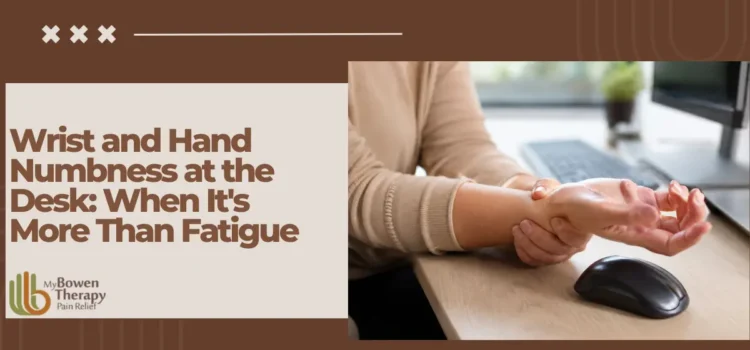
You shake your hand out halfway through the afternoon and carry on. Or you wake at three in the morning with a dead arm and flap it back to life without really waking up. Or the ring and little finger go vague after a long stretch on the mouse, then come back once you stand up and stretch.
Because it passes, hand numbness is easy to file under tiredness. The useful question is how to tell when it genuinely is a desk habit, and when it is worth taking seriously. This article covers the signs that need a doctor, the common desk-related causes, why symptoms are often worst at night, and what actually helps.
Key Takeaways
- Hand numbness and pins and needles usually mean a nerve is being irritated or compressed somewhere along its path.
- The compression is not always at the wrist. It can come from the elbow or the neck.
- Numbness that wakes you at night is a common pattern and worth mentioning to a doctor.
- Weakness, dropping things, or sudden numbness on one side needs prompt medical attention.
- Desk set-up and movement habits matter, but numbness itself should always be medically assessed.
First, the Symptoms That Need Medical Attention
Most desk-related hand numbness is not serious. A few symptoms are, and it is worth ruling those out before reading anything about mouse position.
Call 999 immediately if numbness or weakness comes on suddenly
Particularly if it affects one side of the body, or the face, arm or leg, or comes with drooping on one side of the face, difficulty speaking or slurred words, confusion, or sudden loss of vision.
These can be signs of a stroke. The NHS advises not waiting for symptoms to improve and not waiting for several signs to appear , one is enough. Even if symptoms stop after a short time, get medical help straight away.
See a doctor promptly if you have:
- Weakness in the hand, or dropping things you would normally hold easily
- Difficulty with buttons, keys, or picking up small objects
- Visible thinning or flattening of the muscle at the base of the thumb
- Numbness that is constant rather than coming and going
- Numbness in both hands, spreading up the arm, or affecting your legs
- Symptoms that started after a neck or arm injury
- Changes in walking, balance or coordination alongside hand symptoms
- Numbness with neck pain, unexplained weight loss, or feeling generally unwell
Numbness means a nerve is involved somewhere. That is worth having looked at properly rather than managed from an article, including this one.
Why Do Hands Go Numb and Tingle?
Pins and needles in the hands usually mean a nerve supplying the hand is being irritated or compressed somewhere along its route.
Those nerves start at the neck. They travel through the shoulder, down the arm, past the elbow, through the wrist and into the fingers. Pressure at any point along that path can produce symptoms further down.
This is the part most people miss. Where you feel the symptoms is not necessarily where the problem is. A numb hand does not automatically mean a wrist problem. NHS guidance reflects this, because carpal tunnel symptoms resemble those of other conditions, clinicians often examine other areas as well, particularly the neck.
Sustained positions, repetitive movement and long-held tension all reduce the space nerves have to move and glide. A working day spent largely still, in more or less one shape, is a reasonable description of the conditions under which this happens.
Which Fingers Are Affected, and What That Might Mean
The pattern of which fingers are involved can offer a clue about where along the path the irritation sits.
| Where symptoms are felt | May relate to | Notes |
|---|---|---|
| Thumb, index, middle fingers | Wrist, median nerve | The pattern commonly associated with carpal tunnel syndrome |
| Ring and little fingers | Elbow, ulnar nerve | Often noticed after long stretches with the elbows bent |
| Whole hand, or spreading up the arm | Neck or shoulder region | May come alongside neck or shoulder symptoms |
| Both hands, or hands and feet | General health factors | Worth raising with a doctor |
These patterns overlap, and more than one thing can be going on at once. This is background information, not a way to work out what you have. Only a medical professional can determine the cause, and the assessment usually involves examining the hand, wrist and neck rather than relying on symptom location alone.
Book a free cosultation
Speak with one of our therapists, discuss your concerns and understand whether Bowen Therapy may be suitable for your needs.

Why Do My Hands Go Numb When I Sleep?
Night-time numbness is one of the most commonly reported patterns, and it usually relates to the position wrists and elbows settle into during sleep.
Many people sleep with wrists curled inwards or elbows folded up, which narrows the space nerves pass through. Hold that shape for hours and the nerve protests. Symptoms often ease within minutes of shaking the hand out or letting the arm hang down, which is why it is so easy to dismiss.
It is worth knowing that symptoms being worse at night or first thing in the morning is a recognised feature of carpal tunnel syndrome. NHS guidance describes exactly this pattern.
A few things that sometimes help:
- Avoid tucking your hands under your pillow or under your body
- Try keeping the arm straighter rather than curled up
- Notice whether it is one hand or both, and which fingers, and mention that to your doctor
If it is happening most nights, or you are being woken repeatedly, treat that as a reason to get it assessed rather than something to put up with.
Wrist Pain From Mouse and Keyboard Use
Wrist discomfort from mouse use usually comes from sustained position and repetition rather than any single injury.
The common contributors are unremarkable and easy to miss:
- The wrist held bent back or angled to one side for hours at a time
- The mouse sitting too far away, so you reach for it all day
- A hard desk edge pressing into the underside of the forearm
- Gripping the mouse far more tightly than the task requires
- Working straight through without breaks
The useful principle is variation, not perfection. There is no single correct wrist position that fixes this. The problem is holding any one position for hours, so the fix is moving more often rather than finding the ideal angle and freezing in it.
Worth noting too that neck and shoulder tension often travels with this. Reaching for a mouse all day loads the whole chain from the neck down, which is another reason symptoms in the hand are not always a hand problem.
What Is Carpal Tunnel Syndrome?
Carpal tunnel syndrome is pressure on the median nerve where it passes through a narrow channel at the wrist, causing tingling, numbness, and sometimes pain in the hand and fingers.
The carpal tunnel is formed by the wrist bones and a thick ligament across the top. The median nerve runs through it alongside the tendons that bend your fingers. When the nerve is compressed there, symptoms typically appear in the thumb, index and middle fingers and part of the ring finger, and are often worse at night or first thing in the morning.
In more advanced cases, weakness can develop, along with dropping objects and thinning of the muscle at the base of the thumb. Those are signs to act on rather than monitor.
It is diagnosed by a healthcare professional examining the hand and wrist, sometimes supported by nerve conduction tests, though the NHS notes these are not essential for a diagnosis. It is also commonly reported alongside pregnancy, diabetes, thyroid conditions and some forms of arthritis, associations worth mentioning to your doctor, not a checklist to apply to yourself.
To be direct about our own scope: My Bowen Therapy does not diagnose or treat carpal tunnel syndrome or nerve compression. That is a medical matter.
Practical Adjustments at Your Desk
Most desk-related hand symptoms ease with variation, breaks and small set-up changes. This does not replace having numbness assessed, but it addresses the everyday habits feeding into it.
- Change position regularly. Short, frequent breaks do more than one long one.
- Keep the mouse close enough that you are not reaching for it.
- Support the forearm rather than resting the wrist on a hard edge.
- Keep the wrist fairly neutral rather than sharply bent up or sideways.
- Loosen your grip. Most people hold a mouse far tighter than the job needs.
- Check screen height, since where your neck sits affects the whole chain.
- Look at elbow position too, particularly if symptoms sit in the ring and little fingers.
What Does a Musculoskeletal Assessment Look At?
An assessment looks at the whole path from the neck to the hand, alongside medical assessment of the symptoms themselves
n practice, that means considering neck and shoulder position and tension, the elbow and forearm, how the wrist sits through a working day, your desk set-up, when symptoms appear and what changes them.
It builds a picture of the movement habits around the problem. It does not diagnose nerve conditions, and it is not a substitute for seeing a doctor about numbness.
Book a posture & Movement Assessment
Speak with one of our therapists, discuss your concerns and understand whether Bowen Therapy may be suitable for your needs.
Where Does Gentle Hands-On Care Fit?
Fascia is the connective tissue that surrounds and links muscles throughout the body. Along the chain from neck to hand, it responds to sustained tension and repetitive daily patterns, which is why desk workers so often carry tightness through the neck, shoulder and forearm together.
Bowen Therapy is one gentle, hands-on method used within a wider assessment-led approach. It involves light, precise movements over selected muscles and soft tissues, with short pauses between them. There is no cracking, no forceful manipulation, and no machines, oils or exercises during a session.
To be completely clear: gentle hands-on care is not a treatment for nerve compression or carpal tunnel syndrome, and numbness should always be medically assessed. Where an assessment identifies soft tissue tension in the neck, shoulder, forearm or wrist linked to everyday habits, it may be considered as one way to support comfort.
The nerve symptoms themselves are for a doctor. Anything we do sits alongside that.
Why People Choose My Bowen Therapy
Choosing where to go for support with everyday tension is a personal decision, and it helps to know a little about who you would be working with. At My Bowen Therapy, we start by understanding your posture, movement, areas of tension, and daily habits before deciding what may be suitable.
Our approach is:
- Gentle
- Hands-on
- Non-invasive
- Drug-free
- No machines
- Focused on long-term movement comfort
Our Kuala Lumpur Locations
Visit My Bowen Therapy at our two convenient Kuala Lumpur locations for gentle, hands-on
Bowen Therapy support with pain, posture, tension and movement concerns.

Damansara / TTDI Area
-
 Next to TTDI MRT station
-
 Street parking available nearby
-
 Lift Access Available
-
 Open daily, 9am–5pm
 WhatsApp Us
Near KLCC / Etiqa Twins
-
Located within the KLCC business district
-
Convenient for office workers
-
Escalator & Lift access available
-
Open Tues (8am–4pm), Wed–Thurs (9am–5pm)
Why people choose My Bowen Therapy:
- 22,000+ clients supported across Kuala Lumpur
- 4.9-star Google rating from 700+ verified reviews
- Locations in Damansara/TTDI and KLCC, Etiqa Twins
- Treatments starting from RM130
- Free consultation and posture analysis for new clients
- Suitable for people who prefer a gentle, hands-on approach

My mum has been suffering from carpal tunnel since a year ago. Seeked consultation at a private hospital, did a few rounds of physiotherapy, still the pain persisted. My mum even considered surgery due to the unbearable pain. Suggested her to try out My Bowen Therapy and she felt the improvement with each session since she started 6 months ago. Huge thanks to my mum’s therapist, Ms Olivia Highly recommended

The therapist was very patient & explained the procedure thoroughly. Had a history of recurrent knee injury, backache & carpal tunnel syndrome. After the procedure, I felt light & more mobile. Definitely worth trying it out & will definitely continue a few more sessions to help my body heal.
Worth Paying Attention To
Numbness in the hands means a nerve is involved somewhere between the neck and the fingertips. Often the cause is mundane: a wrist held at an angle for six hours, an elbow folded up all night, a mouse just slightly too far away.
But the location of the symptom does not reliably tell you the location of the problem, and a few signs genuinely need acting on. Weakness, dropping things, constant numbness, or anything sudden and one-sided belongs with a doctor rather than with a new mouse mat.
For everything else, the fundamentals are dull and effective: move more often, vary your position, keep the mouse close, loosen your grip, and pay attention to your neck as well as your wrist.
If you are dealing with desk-related tension and would like a musculoskeletal assessment, you are welcome to get in touch with our team in Kuala Lumpur, alongside, not instead of, seeing a doctor about the numbness itself.
Frequently Asked Questions
Often because of the position wrists and elbows settle into overnight, which narrows the space nerves pass through. Symptoms worse at night are also a recognised feature of carpal tunnel syndrome. If it happens most nights, have it assessed.
Usually irritation or compression of a nerve somewhere between the neck and the hand. That can be at the wrist, the elbow or the neck. General health conditions can also cause it, which is why persistent symptoms should be assessed.
Occasional numbness that resolves quickly is common. Numbness that is constant, worsening, affects both hands, or comes with weakness needs medical assessment. Sudden numbness or weakness on one side is an emergency; call 999.
Weakness and dropping objects can indicate more advanced nerve compression, sometimes with muscle wasting at the base of the thumb, and can also have other causes. This warrants prompt medical assessment rather than self-management.
Keep the mouse close so you are not reaching, support your forearm rather than resting the wrist on a hard edge, keep the wrist fairly neutral, loosen your grip, and take short frequent breaks. Variation matters more than any single position.
Bowen Therapy does not diagnose or treat carpal tunnel syndrome or nerve compression, and numbness should always be medically assessed. Where an assessment identifies soft tissue tension linked to everyday habits, it may be considered as one way to support comfort alongside medical care.