

Written by the My Bowen Therapy team in Kuala Lumpur.
Key Takeaways
- Contact between the kneecap and thigh bone begins at about 20 degrees of bend and peaks around 90 degrees, roughly where your knee sits in a chair. A bent knee is under more pressure than a straight one.
- Stiffness or pain on standing up after prolonged sitting is common enough to have a name. Clinicians call it the theatre sign.
- The first few steps are usually the worst, and it often eases within a minute or two of walking.
- Pain specifically at the back of the knee when straightening the leg is a different pattern and worth having looked at.
- Calf pain or swelling after long periods of sitting, especially with warmth or redness, needs urgent assessment.
It happens on the drive home. Forty minutes on the Federal Highway, and when you finally get out of the car, the knee does not want to straighten. Or you stand up after a long meeting, and the first two steps feel stiff and heavy, like the joint needs a moment to remember what it does.
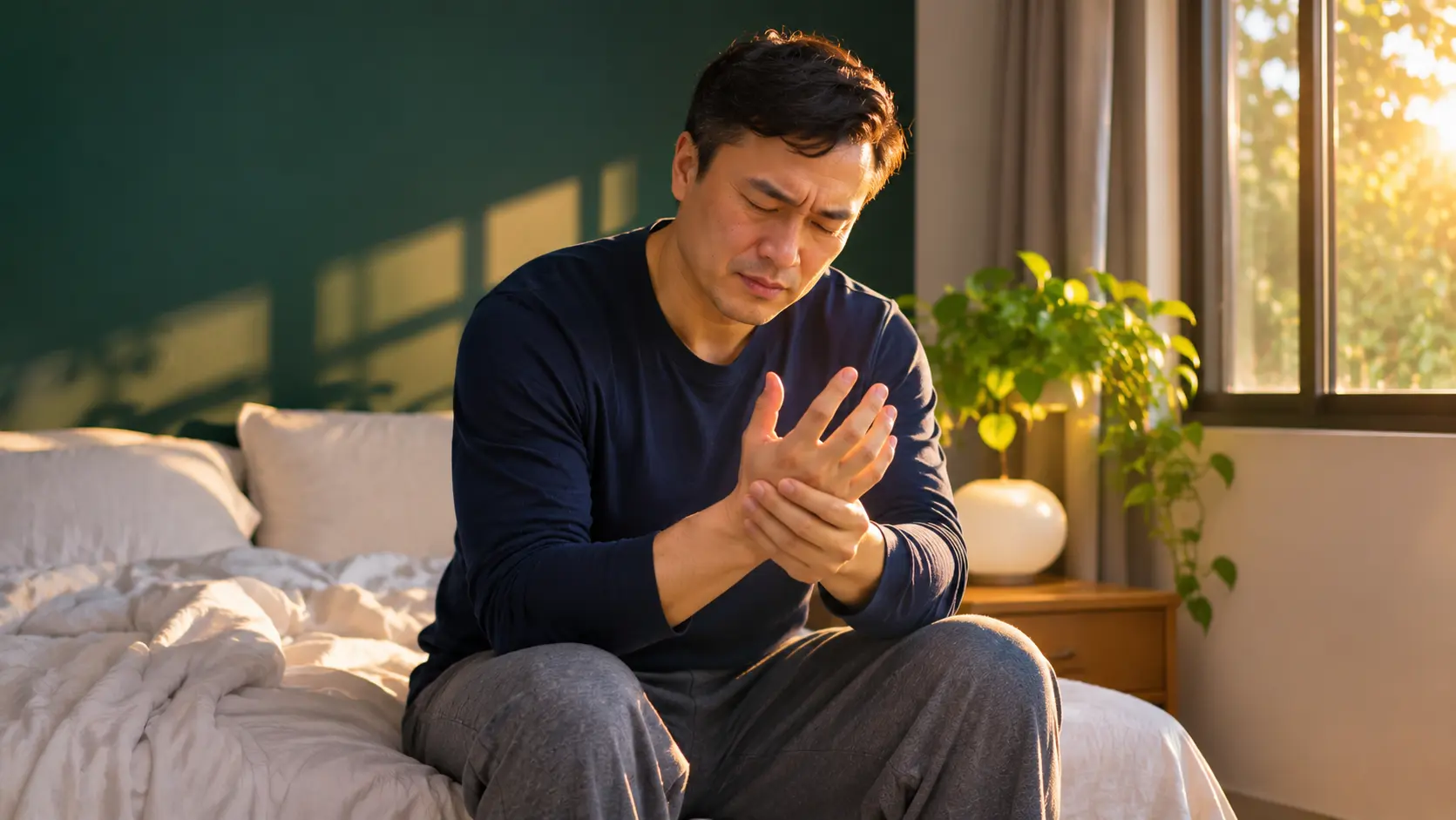
By the time you reach the lift, it has usually eased. Knee pain after sitting for a long time, fine while moving, stiff the moment you stop, is among the most commonly reported knee complaints. This article looks at why sitting specifically does it, what causes knee stiffness in that situation, which sensations deserve attention, and what helps during a desk-bound day.
Why Does a Knee Feel Stiff After Sitting?
A bent knee carries more pressure across the kneecap than a straight one, and holding that position for long periods is what produces the stiffness.
American Family Physician describes the mechanics clearly: contact between the kneecap and the thigh bone begins at around 20 degrees of knee bend and increases to a maximum at about 90 degrees. Ninety degrees is roughly the angle your knee sits at in an office chair, a car seat or a cinema row.
So sitting is not a rest position for the kneecap. It is closer to the opposite: sustained, low-grade pressure for as long as you stay put.
The theatre sign is the clinical name for stiffness or pain that appears after sitting for a long time with the knee bent. The term comes from the experience of standing up after a film. American Family Physician defines it as “stiffness or pain, or both, on prolonged sitting with the knees flexed,” and lists it as a characteristic feature of pain around the kneecap, the most common diagnosis in knee-pain outpatients.
Knowing the name does not diagnose you, but it does mean the experience is well recognised.
What Causes Knee Stiffness After Sitting?
Knee pain after sitting with legs bent usually comes down to three things: sustained position, reduced movement, and what the surrounding muscles are doing while you are still. These causes of knee stiffness overlap rather than acting alone.
| What may be contributing | Why sitting makes it noticeable |
|---|---|
| Pressure across the kneecap | Highest at around 90 degrees of bend, which is the sitting position |
| Little or no joint movement | Movement is what keeps a joint’s lubricating fluid circulating |
| Quadriceps and hip muscles switched off | Muscles that support the knee are doing almost nothing while you sit |
| Shortened position of the hamstrings and calf | Both sit slack in a chair and feel tight on standing |
| A long-standing knee issue | Often asymptomatic while moving, more obvious after rest |
This table is not a way to work out what is causing your own stiffness. More than one factor is usually involved, and the same sensation can have different explanations.
Back-to-back meetings, a long drive in traffic, a cinema trip or a flight out of KLIA all involve the same thing: a knee held at one angle for an extended stretch, with the muscles around it quiet.
There is a Malaysian wrinkle worth naming. Heat and humidity push daily life indoors and into air-conditioned offices, malls, and cars, which means less of the incidental walking that breaks up sitting elsewhere. A desk day in Kuala Lumpur or Petaling Jaya can involve remarkably few unplanned steps.
Why Are the First Few Steps the Worst?
The first few steps are usually the stiffest because the joint has spent a long period without movement, and the muscles supporting it need a moment to switch back on.
Many people describe heaviness in the knee and leg rather than sharp pain, a sense that the limb is reluctant, or the joint feels full. Others notice a brief catch on the first bend.
How long it lasts is the useful detail. Stiffness after sitting typically eases within one to two minutes of walking. Stiffness that loosens as you move is a different picture from stiffness that stays, or from pain that builds the longer you walk.
Swelling in the joint and a knee that locks are not typical of this pattern. Clinical guidance treats locking as a pointer to something else, such as a meniscal problem, and it should be assessed.
Pain in Back of Knee When Straightening Leg After Sitting
Pain specifically at the back of the knee when straightening the leg after sitting is a different pattern from general stiffness, and worth having looked at.
One possibility is a Baker’s cyst, a pocket of fluid that forms at the back of the knee. NHS 111 Wales describes the main sign as a soft lump behind the knee, which may come with tightness, aching, difficulty bending or clicking, and may feel worse after walking. In adults, it usually develops alongside something else affecting the joint, and is most common between 35 and 70.
Tightness through the hamstring tendons, which run either side of the back of the knee, can also produce a pulling sensation at the point of straightening.
The distinction matters because a cyst behind the knee can occasionally rupture, which brings us to the part of this article that is not about stiffness at all.
When Knee Pain After Sitting Needs Medical Attention
Most stiffness after sitting is mechanical and settles with movement. A few patterns need checking, and one is specific to long periods of sitting.
Ask for an urgent appointment, or contact a doctor the same day, if you have:
- Pain or swelling in the leg that suddenly gets worse
- Swelling, bruising or warm skin on the leg
- Red or darkened skin on the leg
- Swelling in the leg that gets harder or softer
NHS 111 Wales notes these can indicate a burst cyst behind the knee or a blood clot in the leg, known as DVT. Long periods of sitting, including long-haul flights, are among the situations where this is considered.
Call 999 if leg pain and swelling come with:
- Breathlessness
- Chest pain
NHS guidance notes this may indicate a clot that has travelled to the lungs, which needs immediate treatment.
Also see a doctor if you have:
- Knee pain after a fall, twist or injury
- A hot, red or swollen knee, or knee pain with a fever
- Pain that is getting worse week by week
If something feels different from your usual pattern, ask.
Ordinary Pattern vs Worth Getting Checked
| An ordinary pattern | Worth getting checked |
|---|---|
| Eases within one to two minutes of walking | Stays, or lasts well beyond the first few minutes |
| No swelling in the joint | Visible swelling in the knee |
| Feels heavy or reluctant, then settles | The knee locks, catches or gives way |
| Comes on after sitting, eases with movement | Pain builds the longer you walk |
| No pain at rest or overnight | Pain at rest, or waking you at night |
| Calf looks and feels normal | Calf pain, swelling, warmth or redness |
This comparison is general information, not a diagnostic test. Patterns overlap, and only a doctor can tell them apart.
What Helps a Stiff Knee During a Desk-Bound Day
What helps most is interrupting the sitting rather than finding a better way to sit. The position itself is the load, so the fix is reducing how long it is held.
- Stand up every 30 to 45 minutes. Frequency matters more than duration.
- Straighten the leg while seated, even for a few seconds, to take the knee out of that 90-degree position.
- Adjust seat height so the knee is not sharply bent and your feet are flat.
- On long drives and flights, use breaks to walk rather than just stretch, and move the ankles and knees while seated.
- Stand up slowly rather than pushing straight through the stiffness.
- Keep generally active. A knee that moves well across the day tolerates sitting better.
These are general principles rather than a programme, and they do not replace medical advice.
What Does a Musculoskeletal Assessment Look At?
An assessment looks at how your knee, hip and ankle move together, and at the sitting patterns that surround the symptom.
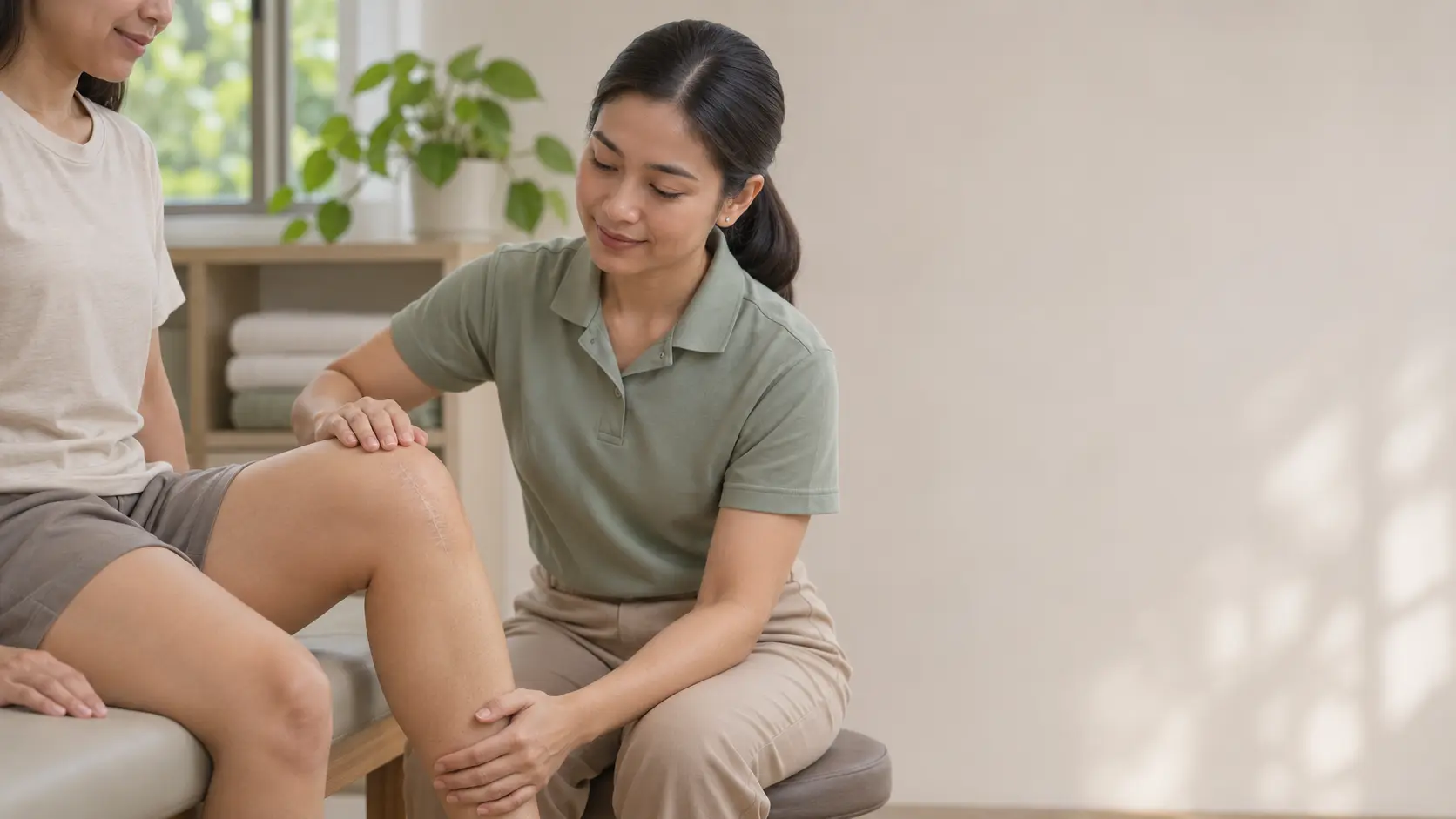
That means how far the knee bends and straightens, what tension is present through the thigh, hamstring, and calf, how the hip and ankle contribute, your desk set-up, and how long you sit in one stretch. It does not diagnose joint conditions, cysts, blood clots, or nerve problems, and does not replace seeing a doctor.
None of it requires any preparation on your part. A first knee pain assessment is mostly conversation and observation, including how the knee stiffens, how long it takes to ease, and what a typical day of sitting actually looks like for you.
If your knee pain is more noticeable on stairs, or you are trying to work out whether it relates to wear in the joint, we cover that in runner’s knee vs early arthritis.
Where Does Gentle Hands-On Care Fit?
Fascia is the thin connective tissue that surrounds and links muscles throughout the body. Around the knee, it connects into the thigh, hamstring, and calf, which is part of why a desk-bound knee often comes with tightness above and below the joint.
Bowen Therapy is one gentle, hands-on method used within a wider assessment-led approach. It involves light, precise movements over selected muscles and soft tissues, with short pauses between them. There is no cracking, no forceful manipulation, and no machines, oils, or exercises.
To be clear about what it is and is not: gentle hands-on care is not a treatment for knee joint conditions and does not replace medical care. Where an assessment finds soft tissue tension around the knee, hip or lower leg linked to everyday habits, it may be considered as one way to support comfort and movement.
Why People Choose My Bowen Therapy
Choosing where to go with a knee that keeps stiffening up is a personal decision. At My Bowen Therapy, we start by understanding your posture, movement, areas of tension, and everyday habits before deciding what may be suitable.
Our approach is:
- Gentle
- Hands-on
- Non-invasive
- Drug-free
- No machines
- Focused on long-term movement comfort
Why people choose My Bowen Therapy:
- 22,000+ clients supported across Kuala Lumpur
- 4.9-star Google rating from 700+ verified reviews
- Established in Kuala Lumpur since 2015
- Locations in Damansara/TTDI and KLCC, Etiqa Twins
- Treatments starting from RM130
- Free consultation and posture analysis for new clients
- Suitable for people who prefer a natural, hands-on approach
Untuk Pembaca Berbahasa Melayu
Lutut kaku selepas duduk lama adalah perkara biasa. Apabila lutut dibengkokkan pada sudut kira-kira 90 darjah, tekanan pada tulang lutut berada pada tahap paling tinggi. Inilah kedudukan lutut anda semasa duduk di kerusi atau di dalam kereta.
Kekakuan ini biasanya hilang dalam masa satu atau dua minit selepas anda mula berjalan. Bangun dan bergerak setiap 30 hingga 45 minit lebih membantu daripada mencari cara duduk yang lebih baik.
Jika sakit terasa khusus di belakang lutut apabila anda meluruskan kaki, itu corak yang berbeza dan patut diperiksa oleh doktor.
Sila dapatkan rawatan segera dengan menghubungi 999 jika kaki anda bengkak atau sakit secara mendadak, kulit menjadi merah atau panas, atau jika terdapat sesak nafas dan sakit dada. Ini mungkin tanda darah beku dan memerlukan pemeriksaan segera.
Klinik kami berada di Damansara/TTDI dan KLCC, Kuala Lumpur.
Stiffness That Eases Is a Different Story From Stiffness That Stays
A knee that stiffens after sitting and loosens within a minute or two of walking is following an ordinary pattern. The position is the load, the muscles have gone quiet, and the joint needs a moment to get going.
What deserves closer attention is anything that breaks that pattern: stiffness that does not ease, swelling, a knee that locks or gives way, pain at night, and most urgently any calf swelling or warmth after a long period sitting.
If your knee stiffens up every afternoon and you would like to understand how your movement and sitting habits feed into it, you are welcome to arrange a musculoskeletal assessment for knee pain with our team in Damansara/TTDI or KLCC. New clients start with a free consultation and posture analysis.
Frequently Asked Questions
Why does my knee hurt after sitting for a long time?
Pressure across the kneecap is highest at around 90 degrees of bend, which is roughly the sitting position. Holding that angle for long stretches, with the surrounding muscles inactive, commonly produces stiffness or pain on standing. Clinicians call this the theatre sign.
What causes knee stiffness after sitting with legs bent?
Usually a combination of sustained pressure across the kneecap, very little joint movement, and the thigh and hip muscles being inactive. Tightness through the hamstrings and calf often adds to the feeling on standing up.
Why does my knee feel heavy after sitting?
Heaviness or a sense of fullness in the knee is commonly described after long periods of sitting, and usually eases within a minute or two of walking. Heaviness that comes with visible swelling in the joint should be assessed.
Why does the back of my knee hurt when I straighten my leg?
This is a different pattern from general stiffness. It can involve tightness through the hamstring tendons, or a Baker’s cyst, a fluid pocket behind the knee that NHS guidance says may cause tightness, clicking or difficulty bending. It is worth having looked at.
Is knee pain while sitting serious?
Usually not. Stiffness that eases with movement is a common mechanical pattern. Leg swelling, calf pain, warmth, or redness after prolonged sitting is different and needs urgent assessment, as it may indicate a blood clot.
Can Bowen Therapy help with knee stiffness?
Bowen Therapy is not a treatment for knee joint conditions and does not replace medical care. Where a knee assessment finds soft tissue tension around the knee, hip or lower leg linked to everyday habits, it may be considered as one gentle way to support comfort and movement.
Where can I get a knee assessment in Kuala Lumpur?
My Bowen Therapy has two Kuala Lumpur locations, in Damansara/TTDI and at Etiqa Twins in KLCC, both offering a free initial consultation and posture analysis. We also see clients travelling from Petaling Jaya and elsewhere in Selangor.
This article is general information and is not a substitute for medical advice, diagnosis or treatment. If you have calf pain or swelling after a long period of sitting, particularly with warmth, redness, breathlessness or chest pain, seek urgent medical care.