

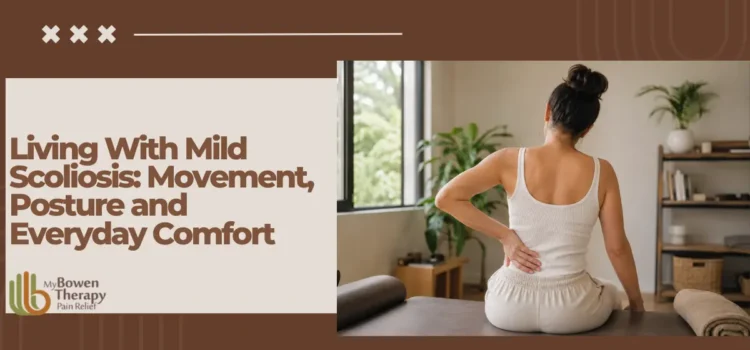
For most people, it arrives sideways. An X-ray taken for something else entirely, a comment from a family member that one shoulder sits higher than the other, or a line on a report that mentions a slight curve. The word scoliosis tends to land a good deal heavier than the finding usually warrants.
Two questions follow almost immediately. Will it get worse, and is this why my back aches? This article looks at what mild scoliosis (skoliosis) actually means, what symptoms are common, how curves are monitored, and what genuinely helps with everyday comfort.
Key Takeaways
- Mild scoliosis means a relatively small sideways curve of the spine, usually monitored rather than actively treated.
- Many people with mild curves have no pain at all, and the curve is often found by chance.
- Back pain in someone with a mild curve frequently has a separate, more ordinary cause.
- Curves noticed in children or teenagers need medical monitoring, because growth is when change is most likely.
- Movement variety and everyday habits can support comfort alongside medical monitoring, not instead of it.
What Is Mild Scoliosis?
Mild scoliosis is a sideways curve of the spine at the smaller end of the scale, usually managed by keeping an eye on it rather than by active treatment.
Curves are measured in degrees using something called the Cobb angle, taken from an X-ray. A sideways curve of less than ten degrees is not classified as scoliosis at all, just a minor asymmetry of the kind most bodies have somewhere.
| Curve size | Commonly described as | Usual approach |
|---|---|---|
| Under 10° | Not classified as scoliosis | No action needed |
| 10–25° | Mild | Observation and monitoring |
| 25–40° | Moderate | Bracing may be considered, mainly during growth |
| Over 40–45° | Significant | Surgery may be discussed |
These bands are general. Decisions depend on age, whether the skeleton has finished growing, the shape and position of the curve, and whether it is changing over time. This table is not a way to assess yourself. Only a doctor can interpret an individual case, and the measurement itself requires imaging.
One point worth knowing: in around eight out of ten cases, no cause is ever identified. The NHS refers to this as idiopathic scoliosis, and notes it is not thought to be linked to things like posture, exercise or diet. If you have been quietly blaming yourself for how you sat at a desk for fifteen years, you can let that go.
What Are the Symptoms of Mild Scoliosis?
Mild scoliosis often causes no symptoms at all. That is why so many curves are found by accident rather than because someone went looking.
Where signs are noticed, they tend to be visual rather than painful:
- One shoulder sitting slightly higher than the other
- One shoulder blade appearing more prominent
- Uneven hips, or a waist that looks asymmetrical
- Clothes hanging unevenly, or a hemline that never sits straight
- A slight lean to one side
Some people also report muscle tightness or fatigue on one side, particularly towards the end of a long day of sitting or standing.
Two things are worth holding together here. The absence of pain does not remove the need for monitoring, especially in a young person. And the presence of pain does not automatically mean the curve is responsible, which brings us to the question most people actually want answered.
Book a free cosultation
Speak with one of our therapists, discuss your concerns and understand whether Bowen Therapy may be suitable for your needs.

Does Mild Scoliosis Cause Back Pain?
Mild curves are frequently painless, and when back pain does occur alongside mild scoliosis, it often has a separate cause. The NHS notes that scoliosis does not usually cause significant pain or other health problems, though back pain is more commonly reported by adults with the condition than by younger people.
This matters more than it might sound. Once someone knows they have a curve, it becomes the explanation for everything. Every ache gets filed under scoliosis, and a perfectly ordinary and very treatable cause goes unexamined for years.
Back pain in someone with a mild curve is often down to the same things it is down to in everyone else. Long hours sitting. A change in activity or load. A period of doing much less than usual. Everyday musculoskeletal strain that would have turned up regardless.
Where a curve may contribute is in how evenly the muscles work across the two sides of the back. Some people find one side fatigues sooner, or holds tension by the end of a long day. That is a comfort issue rather than a structural emergency, and it is the part that responds to sensible everyday adjustments.
Pain does become more commonly associated with larger curves, and with degenerative changes in older adults. That is a reason to keep up with monitoring, not a reason to worry about a small curve.
The practical takeaway: persistent or worsening back pain deserves to be assessed on its own merits, whether or not you have scoliosis. Do not let the curve become the answer before anyone has asked the question.
Scoliosis and Posture: What Actually Helps
Posture work does not straighten a spinal curve. What it can do is influence how comfortable you are through a normal day, which is a smaller claim and a more honest one.
Idiopathic scoliosis is not thought to be caused by bad posture. Posture did not create the curve, and posture will not remove it. But how you sit, stand, carry things, and move still affects how your back feels at nine in the evening.
Some general principles that people find useful:
- Vary your position often. Long static holds tend to be the aggravator, far more than any single “wrong” posture.
- Movement variety beats the perfect chair. Getting up regularly does more than any particular sitting position.
- Check your desk set-up so you are not habitually twisted towards a screen or leaning on one elbow.
- Notice your defaults. Which shoulder carries the bag, which side you hold a phone, which leg crosses over. Small habits, repeated for years, add up.
- Sleep however lets you stay comfortable through the night, using pillows for support where it helps.
- Keep generally active with something you enjoy and will actually keep doing. Walking and swimming both suit most people.
One important caveat. Some specific exercises are not suitable for certain curve patterns, and what helps one person can aggravate another. This is exactly why exercise guidance for scoliosis should come from a professional who has looked at your particular curve, rather than from an article, a video, or a friend with a different spine.
How Is Mild Scoliosis Usually Monitored?
Mild curves are usually monitored rather than actively treated, with the approach guided by a doctor.
In practice, monitoring means periodic review to see whether the curve is staying stable. Reviews are more frequent during childhood and adolescence, because growth is when a curve is most likely to change. The NHS notes that scoliosis tends to stay much the same once growth has finished.
Larger curves, or curves that are progressing, may involve specialist care arranged through a doctor.
To be direct about our own scope: My Bowen Therapy does not treat scoliosis, does not manage or measure spinal curves, and does not provide bracing or curve correction. The curve itself is a medical matter. What we can look at is everyday movement and comfort in people who happen to have one.
When Should You See a Doctor?
Any newly noticed curve should be medically assessed, and curves in children or teenagers need monitoring while they are still growing.
See a doctor if you notice:
- A curve, uneven shoulders, or a prominent shoulder blade in a child or teenager
- A curve that appears to be visibly increasing
- Back pain that is severe, persistent, or wakes you at night
- Numbness, pins and needles, or weakness in the legs
- Breathlessness or difficulty breathing
- A curve appearing for the first time in adulthood
Seek urgent medical care for any loss of feeling around the inner thighs, genitals or back passage, or any change in bladder or bowel control. These are warning signs that need immediate assessment.
None of this is cause for alarm about a small, stable curve. Monitoring exists precisely so that the rare cases that do change are picked up early.
What Does a Musculoskeletal Assessment Look At?
A musculoskeletal assessment looks at how you move and where you carry tension day to day, alongside medical monitoring of the curve rather than in place of it.
That usually means considering how you sit and stand through a working day, which movements feel restricted or one-sided, where tension tends to build, your desk and sleep set-up, your general activity levels, and how symptoms behave over time.
It builds a picture of your daily movement habits. It is not a scoliosis assessment, and it does not measure or manage the curve.
Book a posture & Movement Assessment
Speak with one of our therapists, discuss your concerns and understand whether Bowen Therapy may be suitable for your needs.
Where Does Gentle Hands-On Care Fit?
Fascia is the connective tissue that surrounds and links muscles throughout the body. It responds to sustained tension and to repetitive daily patterns, which is why one-sided tightness is such a common complaint in people who spend long days at a desk.
Bowen Therapy is one gentle, hands-on method used within a wider assessment-led approach. It involves light, precise movements over selected muscles and soft tissues, with short pauses between them. There is no cracking, no forceful manipulation, and no machines, oils or exercises during a session.
To be completely clear about what it is and is not: gentle hands-on care does not change, correct or reduce a spinal curve, and it is not a treatment for scoliosis. Where an assessment identifies muscular tension or discomfort related to everyday movement habits, it may be considered as one way to support comfort.
The curve itself is monitored and managed medically, and anything we do sits alongside that.
Why People Choose My Bowen Therapy
Choosing where to go for support with everyday comfort is a personal decision, and it helps to know a little about who you would be working with. At My Bowen Therapy, we start by understanding your posture, movement, areas of tension, and daily habits before deciding what may be suitable.
Our approach is:
- Gentle
- Hands-on
- Non-invasive
- Drug-free
- No machines
- Focused on long-term movement comfort
Why people choose My Bowen Therapy:
- 22,000+ clients supported across Kuala Lumpur
- 4.9-star Google rating from 700+ verified reviews
- Locations in Damansara/TTDI and KLCC, Etiqa Twins
- Treatments starting from RM130
- Free consultation and posture analysis for new clients
- Suitable for people who prefer a natural, hands-on approach
Our Kuala Lumpur Locations
Visit My Bowen Therapy at our two convenient Kuala Lumpur locations for gentle, hands-on
Bowen Therapy support with pain, posture, tension and movement concerns.

Damansara / TTDI Area
-
 Next to TTDI MRT station
-
 Street parking available nearby
-
 Lift Access Available
-
 Open daily, 9am–5pm
 WhatsApp Us
Near KLCC / Etiqa Twins
-
Located within the KLCC business district
-
Convenient for office workers
-
Escalator & Lift access available
-
Open Tues (8am–4pm), Wed–Thurs (9am–5pm)
Untuk Pembaca Berbahasa Melayu
Skoliosis ringan bermaksud tulang belakang melengkung sedikit ke tepi. Lengkungan ini biasanya kecil, dan selalunya dijumpai secara kebetulan semasa pemeriksaan kesihatan atau X-ray untuk sebab lain.
Ramai orang yang mempunyai skoliosis ringan tidak mengalami sakit langsung. Jika anda mengalami sakit belakang, ia mungkin berpunca daripada sebab lain yang lebih biasa. Doktor anda boleh membantu menilai keadaan tersebut.
Skoliosis dipantau oleh doktor. Pemantauan ini penting terutamanya bagi kanak-kanak dan remaja yang masih membesar. Sila berjumpa doktor jika anda perasan bahu atau pinggul yang tidak seimbang, atau jika lengkungan itu kelihatan bertambah.
Di My Bowen Therapy, kami tidak merawat skoliosis dan tidak mengubah lengkungan tulang belakang. Kami menggunakan pendekatan yang lembut untuk membantu keselesaan harian, pergerakan dan ketegangan otot, bersama pemantauan doktor anda.

I was diagnosed with kyphosis and scoliosis which lead to cervical spondylosis. This condition causes pain in the lower and upper back, numbness in the arms, neck and scary dizzy spells all stemming from nerves impinging on the spinal column. Chiropractic treatments were very painful, uncomfortable and not helping my condition. The non-evasive 1 hour treatments by Dr Carolyn and her team did wonders for me and I would recommend anyone seeking for an alternative means of treatment to give Bowen Therapy a try.

Saya mempunyai masalah sakit pinggang selama bertahun. Saya ingat ianya hanya masalah sakit pinggang biasa. Tapi baru-baru ni pada awal bulan 5 yg lalu, saya disahkan mempunyai masalah mild scoliosis.
Alhamdulillah saya diperkenalkan oleh abang ipar saya mengenai terapi ini. Tidak disangka-sangka, selepas 4 sesi Bowen terapi, masalah sakit pinggang saya hilang & saya dapat rasakan badan saya lebih sihat dari sebelumnya. Saya dapat duduk dengan selesa & lebih yakin melakukan aktiviti-aktiviti sukan yg saya gemari.
Tq so much Nurul Atiqah, you’re the best therapist in Bowen! 👍👍😍 Beliau menjalankan tugas dgn sangat baik, seorang yg peramah & ceria. Beliau telah banyak membantu dalam mengubati masalah scoliosis saya serta memperbaiki posture badan saya.
Beliau juga tidak lokek memberikan info2 yang berguna pada setiap sesi. Terima kasih banyak2 Nurul!!
And thank you so much My Bowen Therapy for all facilities & hospitality. If you’re looking for alternative treatment, this is the best alternative choose for you. Really RECOMMENDED!!
Living Well With a Small Curve
Living with mild scoliosis is, for most people, a matter of monitoring rather than treatment. Many have no pain at all. Many never think about it beyond the occasional appointment.
If you do have back pain alongside a mild curve, the most useful thing you can do is resist assuming the two are connected. There is often an ordinary, addressable cause sitting underneath, and it deserves to be looked at properly.
For everyday comfort, the fundamentals are unglamorous and effective: move often, vary your position, notice your one-sided habits, stay generally active, and keep up with medical monitoring.
If you are living with a mild curve and would like support with everyday movement and comfort, you are welcome to arrange a musculoskeletal assessment with our team in Kuala Lumpur.
Frequently Asked Questions
A curve commonly measuring between 10 and 25 degrees on the Cobb angle. Below 10 degrees is not classified as scoliosis. These bands are general, and only a doctor can interpret an individual case using imaging.
It may stay stable, or it may progress, which is why monitoring exists. Curves tend to stay much the same once growth has finished. Change is most likely during childhood and adolescence.
Often not. Many mild curves are painless, and back pain alongside one frequently has a separate, more ordinary cause. Back pain is more commonly reported in adults with scoliosis than in younger people, and persistent pain should be assessed.
Often none at all. Where signs appear, they are usually visual: uneven shoulders, a prominent shoulder blade, uneven hips, clothes hanging unevenly, or a slight lean. Some people notice one-sided muscle tightness or fatigue.
Usually not. Mild curves are typically monitored rather than treated, with decisions depending on age, curve size, and whether it is changing. Your doctor advises on what is appropriate in your case.
Bowen Therapy does not change or correct a spinal curve and is not a treatment for scoliosis. Where an assessment identifies muscular tension linked to everyday movement habits, it may be considered as one way to support comfort alongside medical monitoring.